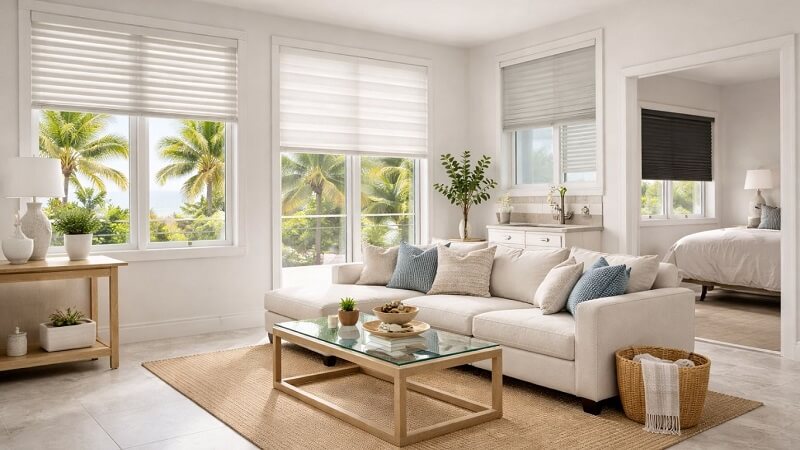
Window treatments behave differently in Miami than they do almost anywhere else in the United States. The intense sun, daily humidity, salt air, and hurricane considerations combine to create conditions that destroy products designed for temperate climates within a few years. Treatments that look beautiful in showroom photos can fade, warp, mildew, or fail mechanically when exposed to South Florida’s actual environment.
This is why the conventional advice about choosing window treatments, which tends to assume mild conditions and indoor stability, often produces poor results for Miami homes. The right choices for a Florida residence are different from the right choices for a New England one, and the differences matter both for the appearance of the home and for the longevity of the investment.
For anyone selecting window blinds in Miami or any other window treatment category, understanding which materials, mechanisms, and design choices actually hold up in this climate is the starting point for any conversation worth having with a window treatment specialist.
Sun Exposure Demands More Than Most Treatments Provide
Miami sees more annual sunlight hours than most of the country, and the angle of the sun for much of the year puts direct light through windows that face south, east, and west for hours at a time. UV exposure on window treatments is consistently among the highest in the country.
The practical effect is that treatments fade faster, fabrics weaken faster, and mechanical components that involve plastic or rubber parts degrade faster. A blind that lasts ten years in a Boston living room may need replacement in three or four years in a Miami one. The category of product that performs is generally not the category that comes from generalist retailers.
Solar shades made from fabrics rated for high UV exposure outperform conventional roller shades for most Miami applications. Faux wood and aluminum blinds outperform real wood blinds in any space that sees significant sun, because real wood warps and discolors under repeated UV exposure. Specialty fabrics like solution-dyed acrylics, designed for outdoor furniture, perform better than standard textile blinds when fabric is involved.
Humidity Affects Materials Differently
Miami’s daily humidity is high enough year-round to affect window treatments in ways that owners in drier climates never have to think about. Real wood blinds absorb moisture from the air and slowly warp, even indoors. Standard fabric treatments can develop mildew when air circulation is limited. Mechanical components that rely on metal springs can corrode over time, especially in homes within a few miles of the ocean.
The fix is selecting materials that are humidity-stable. Faux wood blinds, made from PVC or composite materials, are dimensionally stable regardless of humidity. Aluminum blinds, with proper protective coatings, resist corrosion adequately. Synthetic fabrics treated with antimicrobial finishes resist mildew. Stainless steel hardware lasts where galvanized hardware fails.
These choices add to the cost of the treatment compared to budget alternatives, but the alternatives have a substantially shorter functional life in Miami conditions. Over the time the home is owned, the more expensive option is often the cheaper option.
Salt Air and Coastal Considerations
Homes within a few miles of the coast deal with airborne salt that travels inland on the constant ocean breeze. Salt air accelerates the corrosion of metal components, dulls finishes on hardware, and shortens the life of mechanical parts in ways that are not always obvious until failure happens.
For homes near the water, this matters specifically. Stainless steel hardware should be the default for all visible metal components. Powder-coated finishes hold up better than painted ones. Mechanical components should be specified for marine environments where possible. Lift cords and operating mechanisms should be inspected periodically and replaced before failure, since corrosion can cause sudden mechanical problems with otherwise good-looking treatments.
Hurricane Considerations Affect Mounting and Choice
Hurricane season runs from June through November, and any window treatment in a hurricane-prone area should be specified with that in mind. The treatments themselves rarely survive a hurricane intact if the window fails, but treatments installed in homes with hurricane shutters or impact-resistant windows need to be specified to work with those systems.
Treatments mounted to walls need adequate anchoring to resist wind loads that can develop even when windows themselves hold. Cordless systems are now the standard, both for safety with children and pets and to eliminate cords that can become wind hazards if a window does break.
For homes with motorized treatments, the control systems should be specified to handle the surge conditions that can occur during severe storms. Smart controllers with proper surge protection are worth the additional cost.
The Categories That Hold Up Best in Miami
Several categories of window treatment have track records of performing well in South Florida conditions:
- Faux wood blinds, particularly higher-end composite formulations, provide the look of wood without the warping or fading.
- Aluminum blinds with marine-grade powder coatings hold up well in coastal environments.
- Roller shades made from solar screen fabrics, particularly those rated for outdoor or marine use, provide light control and UV protection while resisting fade.
- Cellular shades with synthetic fabric construction provide insulation benefits without the moisture issues of natural fiber alternatives.
- Drapery using indoor-outdoor fabrics from manufacturers like Sunbrella holds up under sun exposure that destroys conventional drapery fabrics.
- Plantation shutters made from synthetic materials, rather than real wood, resist the warping that affects wood shutters in this climate.
Working With a Specialist Who Knows the Climate
The most useful predictor of whether a window treatment investment will perform well is whether the person specifying it understands the local conditions. Specialists who work primarily with Miami homes know which products fail, which manufacturers stand behind their products in this climate, and which combinations of style and material actually hold up.
This knowledge is not always available from generalist installers or from online retailers. The right specialist asks specific questions about exposure direction, proximity to the ocean, intended use, and aesthetic preferences, and matches the answers to product categories that have proven track records. The wrong specialist simply sells whatever is on promotion at the moment.
The Bottom Line
Miami window treatments need to be selected for the climate they will live in, not for general aesthetic appeal. Sun, humidity, salt air, and hurricane considerations all affect which products perform and which fail prematurely. Treatments specified with these factors in mind look beautiful and last for years. Treatments specified without them look beautiful for a season and then begin to disappoint.
The right window treatments in a Miami home are an investment that pays back over time. The wrong ones become an expense that has to be repeated. Knowing the difference, and working with people who understand the difference, is what separates the two outcomes.