
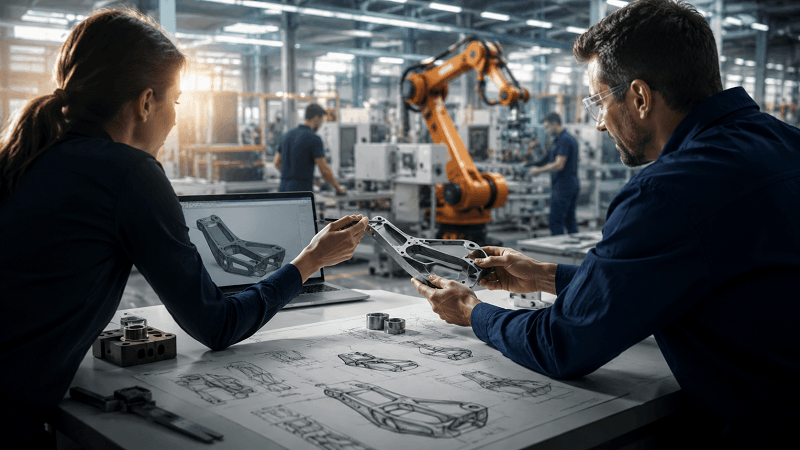
For most of the product development history, manufacturing was the final handoff. A design team would spend months refining a concept — shapes, materials, tolerances — and then pass it downstream to engineers and fabricators who were expected to figure out how to build it. The result was predictable: late-stage redesigns, cost overruns, and products that looked nothing like the original vision.
That model is losing ground. Across industries from aerospace to architecture, a different approach has taken hold — one where the constraints of manufacturing are introduced at the very start of the design process, not at the end.
Design Intent vs. Manufacturing Reality
The tension between what a designer imagines and what a factory can actually produce has always existed. But for much of the twentieth century, it was treated as a problem to solve after the fact. Products were conceived in isolation from the processes that would create them, and the gap was bridged through compromise.
That compromise is expensive. Engineers are forced to reverse engineer a design for production to introduce geometry changes that alter structural performance. Material substitutions made late in development affect weight, durability, and finish quality. Each revision adds time, and time in product development directly translates to market delay.
What manufacturing-first design thinking challenges is the assumption that creativity and production constraints are at odds. They are not. Knowing that a panel must be laid up at a specific fiber angle, or that a mold requires draft angles to release cleanly, does not restrict a designer — it focuses on them. The constraint becomes a parameter, and working within parameters has always produced a sharper design.
The Rise of Manufacturability as a Creative Discipline
Several industries have quietly made this shift already. Automotive suppliers who work on high-performance vehicles rarely treat fabrication as separate from styling. The surface geometry of a body panel is inseparable from how it will be tooled. The same is true in marine design, where hydrodynamic performance and composite layup schedules are worked out together rather than sequentially.
What makes this shift more accessible now is the maturation of design software capable of holding both worlds simultaneously. Tools that model surface aesthetics can also evaluate structural behavior and flag manufacturability issues in the same environment. A
designer sketching a compound curve no longer must guess whether it can be produced — the geometry itself carries that information.
This is where custom composites have redefined what’s possible. By allowing designers to specify material behavior alongside form, composite-based development collapses with the traditional boundary between the design studio and the production floor. The material is not selected after the shape is finalized — the material properties are part of what generates the shape.
What Brands Gain from Integrating Engineering Early
The business case for manufacturing-integrated design is straightforward, but it goes deeper than cost savings. Speed is a more compelling argument. When engineering input arrives at the concept stage rather than after tooling has begun, iteration happens in software rather than in physical prototypes. Fewer physical builds mean fewer weeks lost to fabrication cycles.
There is also a quality argument. Products designed with manufacturing in mind from the start tend to hold their specifications across production runs. Tolerances that are achievable are specified from day one, rather than tightened or loosened under pressure at the end of development. The result is a product that performs consistently, not just impressively, in the prototype phase.
For smaller brands and independent product developers, the implications are significant. Access to advanced manufacturing capability no longer requires an in-house engineering team. Design-for-manufacturing knowledge can come from the fabrication partner itself, embedded in the collaboration rather than carried as internal overhead.
The New Relationship Between Designer and Maker
What this trend describes, at its core, is a change in how the designer-maker relationship is structured. Historically, makers executed what designers specified. The knowledge flow was one-directional. In manufacturing-integrated design, that relationship becomes bidirectional. The fabricator’s knowledge of material behavior, tooling limits, and process variables shapes the design as it develops — not after it arrives.
This is not a diminishment of design creativity. It is a redistribution of where creative decisions are made. Form, material, and process become a single conversation rather than a sequence of separate decisions handed from one team to another.
The products that result from this approach tend to be harder to copy, not because they are patented but because the design logic is inseparable from the production method.
Geometry makes sense only in the context of how it is built. That kind of integrity is difficult to replicate without understanding both sides of the equation.
Industries that have already made this shift — aerospace, performance automotive, advanced marine — have produced some of the most formally and structurally coherent products in the manufactured world. The rest of the product design landscape is catching up, and the factories are waiting at the table.