
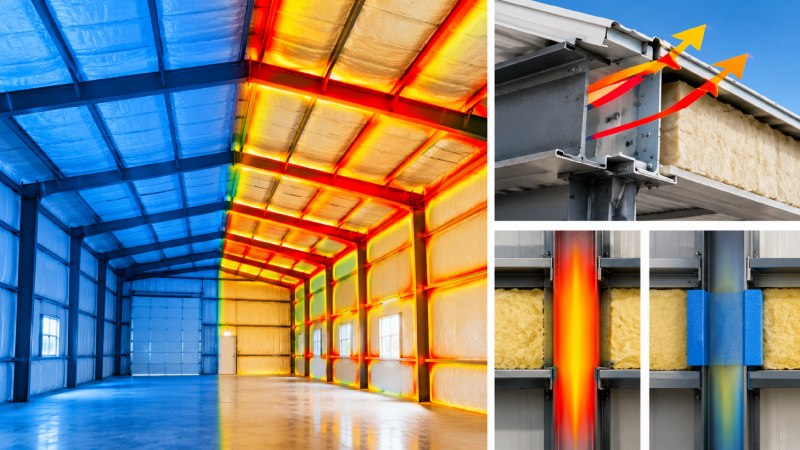
If you have ever walked into a steel building on a cold morning and felt the chill coming off the walls before you even reached the center of the room, you have experienced thermal bridging firsthand. Steel is an excellent structural material, but it is also one of the most efficient heat conductors you can put in a wall. Every purlin, girt, and frame that touches both the inside and outside of the building becomes a highway for heat to escape, and the result is a structure that costs more to heat, sweats when the weather turns, and never quite feels comfortable. Understanding why this happens is the first step toward fixing it.
What Is Thermal Bridging?
Thermal bridging occurs when a highly conductive material creates a continuous path between the warm and cold sides of a building envelope. Heat always moves from warm to cold and takes the easiest route. In a wood-framed house, the studs are mild bridges. In a steel building, the bridges are dramatic: steel conducts heat roughly 300 to 400 times faster than wood, so a metal frame member passing through the insulation layer can move more heat than the entire insulated bay next to it.
The effect is easy to see with an infrared camera. The insulated cavities show up as a cool, even color, while the steel framing glows as bright stripes of heat escaping to the outside. Those stripes are where your energy budget is leaking out.
Why Steel Buildings Are Especially Vulnerable
Three design features make pre-engineered metal buildings prime candidates for heat loss:
- Framing passes straight through the envelope. Purlins and girts run from the interior finish to the exterior sheeting with no interruption. Insulation is typically laid over or between them, but the metal still contacts both faces.
- Fasteners multiply the problem. Thousands of self-drilling screws connect the roof and wall panels to the frame. Each one is a small but real bridge, and together they add up.
- Compressed insulation performs poorly. Traditional faced fiberglass blanket systems compress where they cross the framing, collapsing their R-value exactly where the building needs it most.
The outcome is a building whose “nominal” R-value on paper can be twice as high as its real-world effective R-value once bridging is accounted for.
The Hidden Costs: Condensation, Corrosion, and Comfort
Heat loss is only part of the story. When warm, humid interior air meets a cold steel surface, moisture condenses. In a metal building, this shows up as dripping purlins, rust streaks on the ceiling liner, wet insulation, and staining on stored inventory. Over time, chronic condensation accelerates corrosion of the structure and further degrades the insulation’s performance, creating a cycle that worsens every winter.
Occupant comfort suffers too. Cold interior surfaces radiate chill inward, so a shop can feel cold even when the thermostat reads a comfortable number. Owners respond by running heaters longer and harder, which drives the energy bill up without addressing the cause.
How to Reduce Thermal Bridging in a Metal Building
The principle is simple: break the path. Any strategy that separates the steel frame from one side of the envelope, or wraps the frame in a continuous layer of insulation, will dramatically cut heat loss.
- Add a thermal break. Thermal spacer blocks or foam tape between the purlins and the roof panels interrupt the metal-to-metal contact that drives the worst bridging.
- Use continuous insulation. A layer of rigid board or an uninterrupted liner system that runs across the inside face of the framing keeps the steel on the warm side of the insulation, so it never reaches the dew point.
- Stop compressing the blanket. Liner systems that hold insulation at full loft between the framing members preserve the rated R-value instead of crushing it.
- Seal the air leaks. Bridging and air infiltration go hand in hand. A properly sealed vapor retarder keeps humid air from reaching cold surfaces.
- Retrofit, don’t rebuild. For existing buildings, modern retrofit systems install over the current structure without removing roof or wall panels, making them practical even for occupied facilities.
This is where metal building insulation from CMI come in: purpose-built retrofit systems that create a continuous, full-depth insulation layer inside an existing steel structure, eliminate compression at the framing, stop condensation at its source, and deliver an effective R-value that matches the spec sheet.
Signs Your Building Has a Thermal Bridging Problem
Not sure whether bridging is costing you? Look for these symptoms:
- Frost or condensation forming in lines that follow the roof purlins
- Heating bills that climb every year despite no change in use
- Visible rust streaks or water stains on the ceiling or upper walls
- Insulation that looks sagged, wet, or discolored near the frame
- A noticeable temperature difference between the center of the building and the perimeter
Any one of these points to heat escaping through the frame rather than through the insulated bays.
Frequently Asked Questions
Does thermal bridging affect summer cooling as well? Yes. The same metal paths that let heat out in winter let it in during summer, so bridging increases air conditioning loads and creates hot spots near the roof and walls.
Can I fix thermal bridging without replacing the roof? In most cases, yes. Interior retrofit insulation systems are designed to install beneath existing roof and wall panels, keeping the building weather-tight throughout the project.
How much energy can a thermal break save? Studies of pre-engineered metal buildings often show that addressing bridging and compression can improve the roof assembly’s effective R-value by 30 to 50 percent, with proportional reductions in heating and cooling costs.
Is spray foam the only answer? No. Spray foam is one option, but liner systems with full-loft insulation and a dedicated thermal break often deliver comparable performance at a lower cost, without the access or ventilation challenges of foam application.
Steel buildings lose heat fast because steel conducts it. The frame that holds the building up is the same frame that carries warmth straight outside, and no amount of extra heating capacity will outrun that physics. The fix is not more heat; it is a better-designed envelope that keeps the steel warm, the insulation uncompressed, and the moisture where it belongs. Address the bridge, and the rest of the building’s performance follows.