
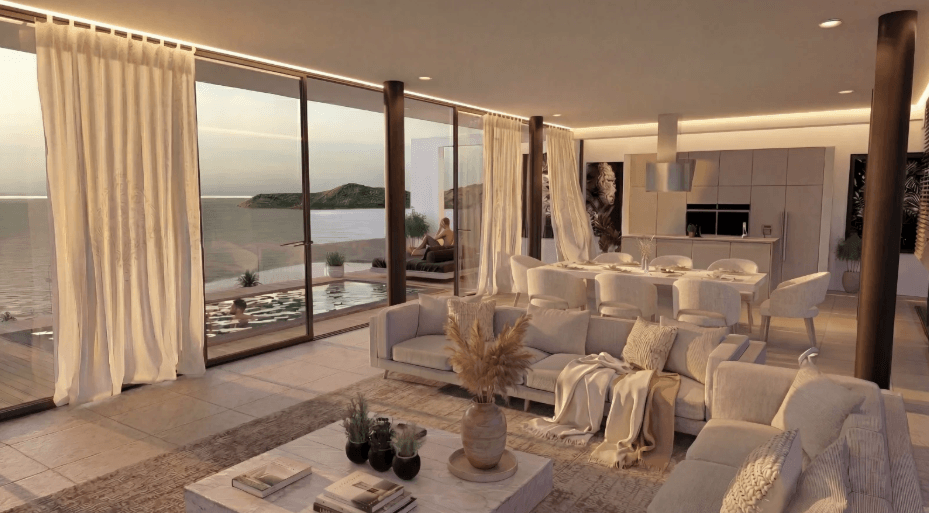
I have stood on a lot of coastal plots over the years. Cliff edges dropping straight to the sea. Quiet bays lined with coconut palms. Fully exposed hilltop sites with wind hitting from three directions at once.
Every time, the first feeling is not inspiration. It is a responsibility.
A coastal site is never a blank canvas. It has its own personality, its own demands, its own rules. As a Koh Samui architect, the architecture we place on it either respects that, or it doesn’t. There is very little middle ground.
The Coast Changes Every Design Variable
Designing for a coastal location is fundamentally different from designing anywhere else. Not just because of the view — but because of what the coast does to every other variable in the process.
- Light bounces off the water, arrives from multiple angles, and shifts dramatically across the day
- Wind is constant — either an asset or a problem, depending entirely on how the building responds to it
- Rain arrives suddenly and heavily in a tropical climate, and the building must handle it every time
- Humidity is ever-present, affecting every material decision and every construction detail
In Architecture Koh Samui, these are not background conditions. They are the primary design inputs — and tropical architecture is the only design language that takes all of them seriously from day one.
It Was Never About Aesthetics
Tropical architecture is often misunderstood as a visual style. Open pavilions. A resort-like look applied as surface treatment to buildings with no real understanding of the climate underneath.
That is not what we practice at Adoani Architects.
For us, tropical architecture is a problem-solving discipline. Every decision — the angle of a roof, the depth of a shade structure, the position of an opening — is made in direct response to what the climate and the site are asking for.
The Questions We Ask Before Anything Else
- Where does the sun rise and set relative to this plot — and what does that mean for room orientation?
- Where does the prevailing wind come from, and how does the building receive it?
- How does rainwater move across this site, and how must the architecture respond?
- At what time of day is the view most extraordinary — and which spaces should face it?
- How exposed is this site, and how sheltered does the architecture need to be in return?
These questions have nothing to do with style. But they determine everything about how a coastal home will feel to live in — day after day, year after year.
Shade Is Not a Luxury. It Is the Architecture.
This is one of the most important mindset shifts in serious tropical coastal design.
In most architectural traditions, shade is secondary. It is managed by curtains and blinds after the building is already complete.
In tropical Architecture Koh Samui, shade is the primary architectural move. Everything else follows from it.
A home on the Koh Samui coast that does not manage shade correctly will be deeply uncomfortable to live in. The afternoon sun from the west, reflected off the water, is extraordinarily intense. Without a considered architectural response — not blinds, not curtains, but actual built shade — the home becomes a place you retreat from rather than want to be in.
How We Approach Shade on Every Project
The solution changes with every site and every orientation. It is never generic.
- A cantilevered roof plane on an exposed west-facing site
- Vertical fins that cut the afternoon sun without closing the sea view
- A planted pergola that dissolves the boundary between architecture and landscape
- Deep covered terraces that make outdoor living genuinely comfortable at any hour of the day
The principle is always the same: shade designed into the architecture from the very beginning — not considered after the fact.
Opening Up — And Knowing When Not To
Every conversation about tropical coastal homes eventually comes back to the same idea — opening the interior to the outside. And it is true. That connection is fundamental to what makes Koh Samui luxury villa design feel the way it does.
But there is a more honest conversation that happens less often. Knowing when not to open up.
A home that is fully open in every direction is not a tropical home. It is a platform with a roof.
How We Balance Openness and Shelter
Primary living spaces open fully toward the view and the prevailing breeze. This is non-negotiable on any coastal site we work on.
The entry sequence is deliberately compressed and sheltered before the main space is revealed. That contrast — compression then expansion — gives the openness its full meaning and emotional impact.
Bedroom wings are more protected and controlled. The coast is extraordinary at sunrise. But a bedroom fully exposed to sea wind and morning glare at six in the morning is not restful — it is exhausting.
Service areas and circulation are positioned on the sides of the building facing the harshest sun or least interesting views — freeing the primary spaces entirely for the experience that makes coastal living worth it.
Designing for Water in All Its Forms
On a coastal site, water is everywhere. And not just the sea.
Heavy tropical rainfall. Constant humidity. High water tables on low-lying coastal plots. Salt air reaches every surface and every fitting that faces the water.
As Koh Samui villa architects, designing for a coastal tropical environment means designing for water in every form it takes.
What This Demands in Practice
- Roof geometry that directs heavy rainfall away from openings without complex, maintenance-heavy drainage systems
- Site grading and drainage that handles sudden tropical downpours without flooding terraces and pool decks
- Building envelope detailing that manages moisture from constant coastal humidity — not just visible rain
- All external fixings and frames specified for genuine marine-grade exposure — standard hardware corrodes quickly in sustained salt air
None of this is glamorous. But it is where the real quality of a coastal home is built or lost.
A terrace that floods every wet season. A ceiling with water staining after two years. A window frame that corrodes by year five. No amount of beautiful design compensates for these failures.
The Two Things Clients Remember Most
In our experience across interior design Koh Samui and the wider coastal region, most people expect to talk about views and finishes when they move into a new coastal home.
But the things they actually talk about — months and years later — are rarely visual.
Sound
The sea has a rhythm: waves, wind, and water moving through coastal vegetation. A well-designed coastal home keeps that sound present throughout the day — not as noise, but as a quiet, constant reminder of exactly where you are.
A home that is too sealed loses this entirely. The acoustic connection to the coast matters, and we think carefully about how each space is opened, oriented, and detailed to preserve it.
Light
Coastal light changes more dramatically across the day than almost anywhere else. The difference between the light at seven in the morning and the light at four in the afternoon on a Koh Samui coastal site is genuinely extraordinary.
As an interior designer, Koh Samui works closely with the architect to capture this:
- Which rooms benefit most from soft morning light
- Which spaces come alive in warm afternoon light
- How the architecture is positioned to capture the remarkable quality of light in the hour before sunset over the Gulf of Thailand
A home designed around a single static light condition misses everything the coast actually has to offer.
What Brings It All Together
Every challenge a coastal site presents — the light, the wind, the rain, the heat, the humidity, the salt air — has a considered answer within the principles of tropical architecture.
This is exactly why, in our work as Adoani Architects, we return to these principles on every coastal project we take on. Not out of habit, but because they work. They were developed precisely for environments like this one — and when they are applied with care, precision, and a genuine understanding of the site, the result is a home that does not simply occupy the coast.
It belongs to it.
Not a home with a view. A home that is inseparable from the place it sits in. That is what great coastal architecture looks like — and that is what we work toward on every project at Adoani Studio.